Deepavali 2026 in Little India: the lights, the lanes and the dates.
Serangoon Road lights up on 3 October and stays lit until 29 November; the festival itself falls on Sunday 8 November. The dates, the Festival Village on Campbell Lane, the two temples and how to walk into them, the museum that closes on the holiday Monday, and the evening we would plan around all of it — every fact linked to the organiser or the public body that published it.
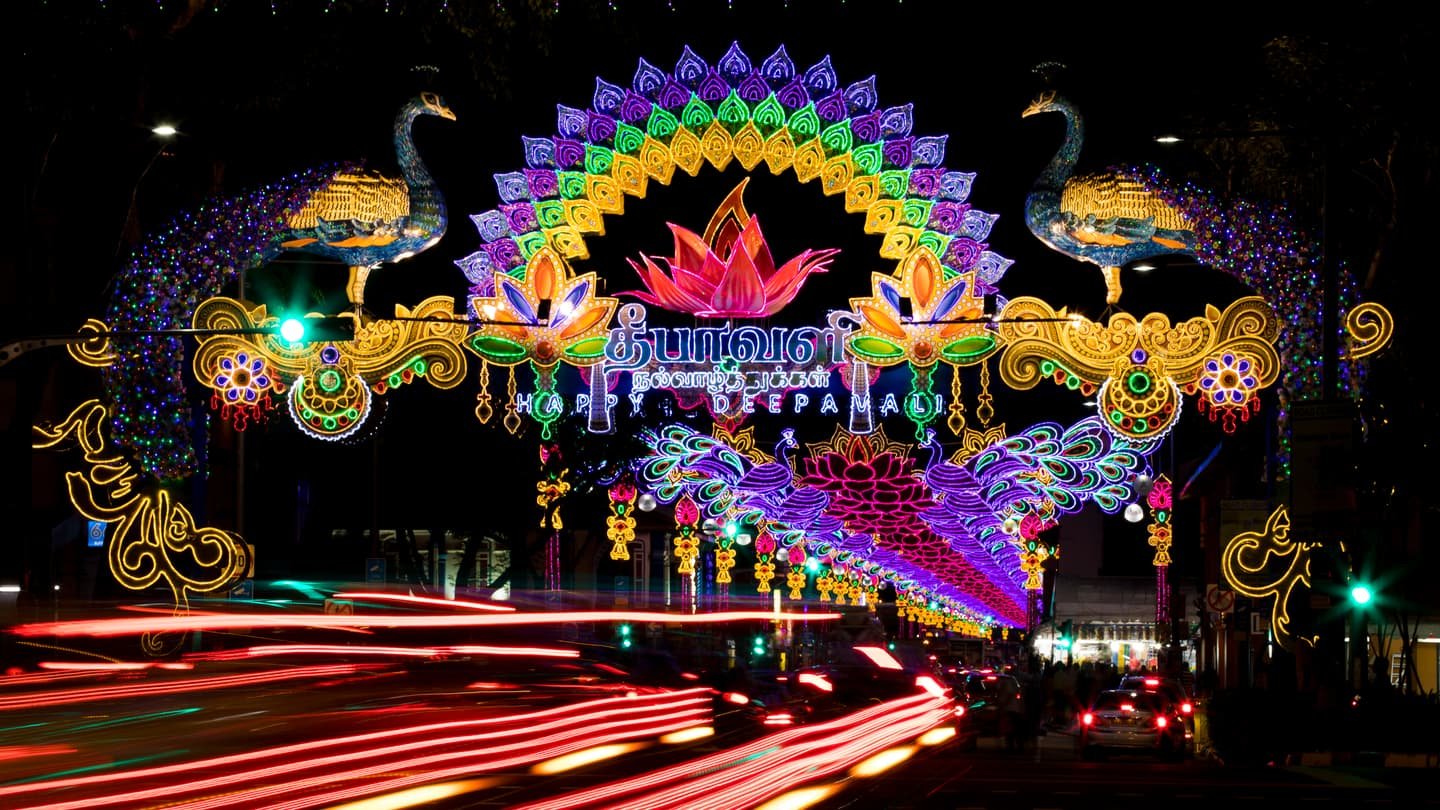
Serangoon Road during the 2016 light-up. Cropped and resized from a photograph by Cpgfella, CC BY-SA 4.0; this version is shared under the same licence.
Published: 24 September 2026 · 8 min read
Sunday 8 November, and the eight weeks of light around it
Deepavali falls on Sunday 8 November 2026, and because it lands on a Sunday, the Ministry of Manpower has made Monday 9 November the public holiday. The word means a row of lights, and the festival, in the National Heritage Board's own words, marks the triumph of good over evil, light over darkness and knowledge over ignorance. It falls in the Tamil month of Aipasi, it has been a public holiday in Singapore since 1929, and it is kept by Hindus and by Indians of other faiths, among them Sikhs and Jains.
For a visitor, the day itself matters less than the weeks around it. The Little India Shop Owners and Heritage Association, LISHA, runs the festival it calls Deepavali Thiruvizha, and this year it spans fifty-eight days, from 3 October to 29 November. That is the window in which Serangoon Road is lit, and it runs three weeks past the day itself — so a trip in late November still catches the lights, and one in early October sees them new.
Much of Deepavali happens at home: the house cleaned and decorated weeks ahead, new clothes, an oil bath before the morning prayers, and blessings from the eldest of the family. What a visitor can share is the public half — the street, the bazaar, the temples and the food — and nearly all of it is in one neighbourhood. Our neighbourhood guide sets Little India beside the rest of the city if this is your first look at it.
Serangoon Road after seven, when the arches come on
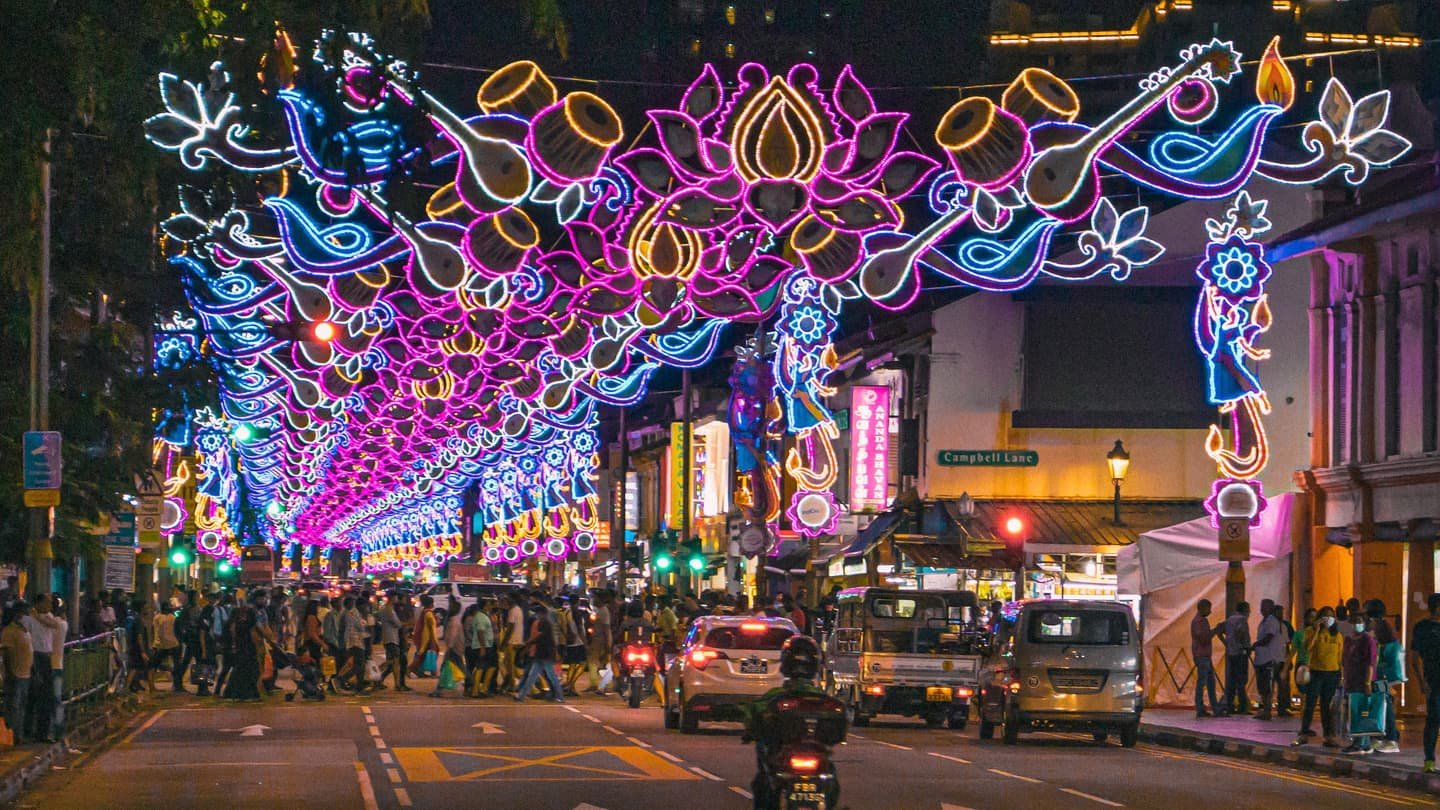
The light-up is the part everyone photographs. LISHA's own description has it stretching over two kilometres along Serangoon Road, switched on at a ceremony on Birch Road at 7pm on Saturday 3 October, and lit every evening from seven until midnight for the rest of the festival. The street and temple photographs on this page were taken at earlier festivals, so they show the style of the thing rather than this year's arches.
Walk it rather than drive it. The Singapore Tourism Board lists Little India (NE7/DT12) and Jalan Besar (DT22) as the nearest MRT stations, and from Little India the road runs north-east under the arches, past the temples and the shophouses, for as long as your feet want it to. The lights come on at seven, and a sky that has had half an hour to go properly dark makes them brighter — so arrive at about half past.
If you would rather see it without the crowds, go on a weeknight. Nearly all of the festival's organised events, listed below, are on Saturdays, and the weeknight lights are the same lights. The last trains run at about the hour the lights go off, and our guide to getting around Singapore covers what to do when they have gone.
Campbell Lane becomes the Festival Village
From Saturday 10 October to Deepavali itself on 8 November, Campbell Lane, the short street off Serangoon Road beside Little India Arcade, becomes the Festival Village. LISHA opens it daily from 7pm to midnight, with stalls of traditional clothing, festive snacks, handicrafts and decorations, and the merchants on the lane extend their shops out into it. It is a bazaar in the older sense: the place families come for what the day needs, which the heritage board's entry lists as new clothes, jewellery, decorations and the sweet and savoury snacks made weeks ahead.
Two Saturday evenings carry music as well. Sangeetham Under the Stars is free, on the Campbell Lane Open Stage on 17 and 31 October from 8pm to 10pm, and runs from Carnatic classical music through fusion to Bollywood, with a showcase for emerging artists, according to LISHA's programme. The same programme has residents and People's Association volunteers making a large community kolam on the lane — the pattern of coloured rice powder that is drawn at doorways for the festival.
Carry small notes as well as a card. Our note for first-time visitors explains why the city's best cheap things still run on cash, and a lane of festival stalls on a Saturday night is exactly where the difference shows.
Serangoon Road at the corner of Campbell Lane during the 2022 festival. Cropped and resized from a photograph by Iybtk, CC BY-SA 4.0; this version is shared under the same licence.
A Saturday for the workshops and the headset walk
LISHA's programme puts its hands-on sessions on Saturdays, and they are small, so they need registering for on the festival site. The one we would pick for a visitor is Journey Through Time, a heritage walk with portable AR and VR headsets through the Sri Veeramakaliamman Temple, Tekka Market and Little India Arcade, every Saturday from 10 October to 7 November at 6pm, for S$15 a person. It starts an hour before the lights come on, which makes it the natural first half of an evening.
Two craft sessions suit families. Clay Diya Painting at Tekka Place, on 17 and 31 October from 2pm to 4pm, is free with registration for thirty people, and decorates the small terracotta oil lamps that are lit at doorways for the festival. On the same two Saturdays, from 11am to 1pm on Campbell Lane, a spice-blending masterclass with a local chef makes garam masala and sambar powder to take home, at S$8 for twenty places.
Two temples on Serangoon Road, and how to walk into them
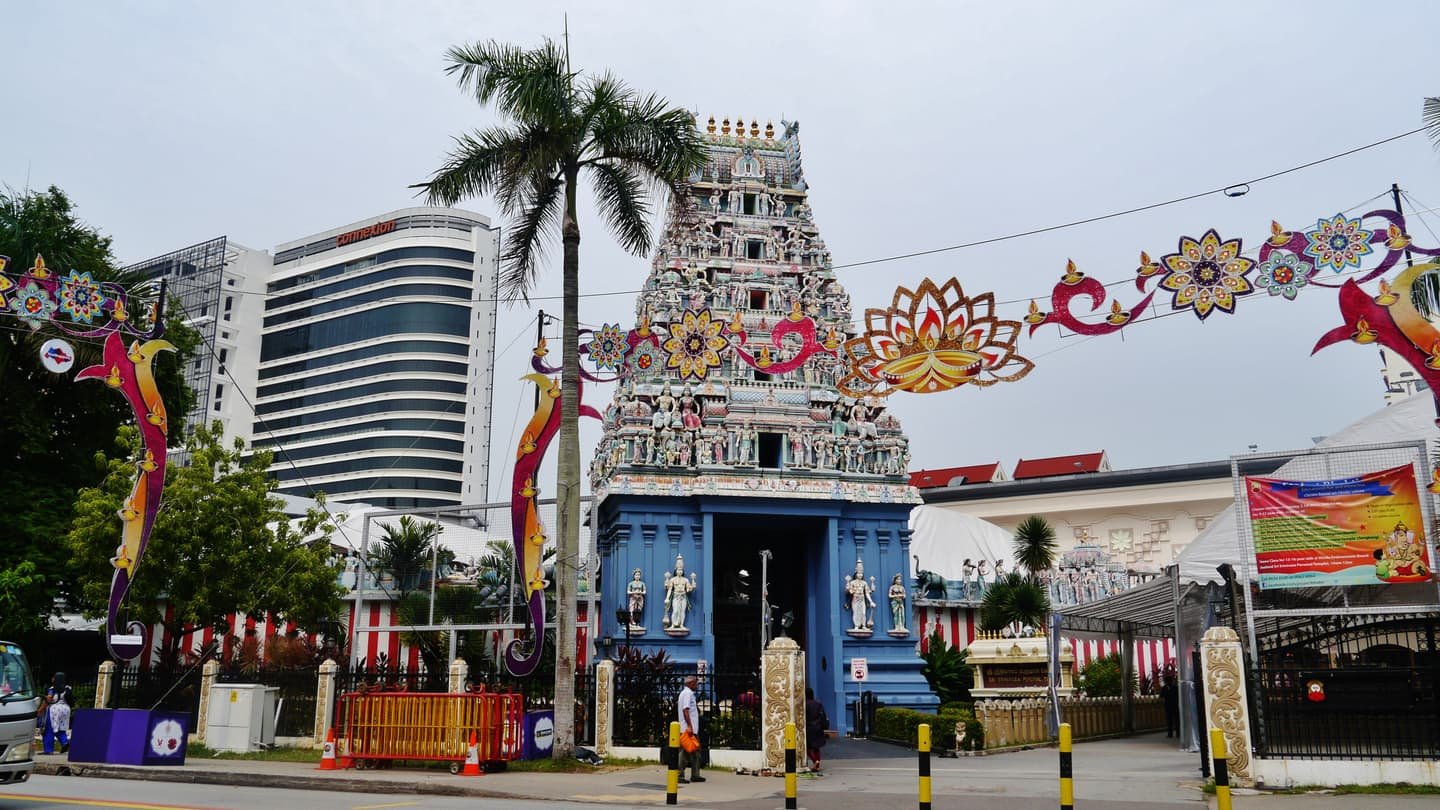
Sri Srinivasa Perumal Temple, at 397 Serangoon Road, is a National Monument and the first Hindu temple in Singapore dedicated to Vishnu. Its land was bought from the East India Company in 1851 and the first temple built on it in 1855; the building you see was completed in 1966, with the five-tier gopuram — the entrance tower carved with Vishnu's avatars and other deities — that makes it visible far up the road. The Hindu Endowments Board, which runs it, lists weekday opening from 5am to 11am and again from 6pm to 8.30pm, with different hours at the weekend.
Further down the road towards Little India station, the Sri Veeramakaliamman Temple was built by Indian pioneers of the Serangoon district in the nineteenth century and is dedicated to the goddess Kali. Both are working temples in the busiest weeks of their year, and the way to see them is as a guest at worship rather than as a sight on a list.
The etiquette is short, and the Hindu Endowments Board publishes it: cover your shoulders and your knees, and wear nothing too tight or too short; temples lend shawls and wraps to anyone who arrives without. Shoes come off outside, where there is usually a space set aside for them, and socks can stay on unless the floor is slippery stone. Do not go into the shrines or sanctums, do not sit with your feet pointing at the deities, the priests or anyone else, keep your voice down, and treat the priests with respect.
Sri Srinivasa Perumal Temple, dressed for the 2015 festival. Cropped and resized from a photograph by Zairon, CC BY-SA 4.0; this version is shared under the same licence.
An hour at the Indian Heritage Centre, but not on the Monday
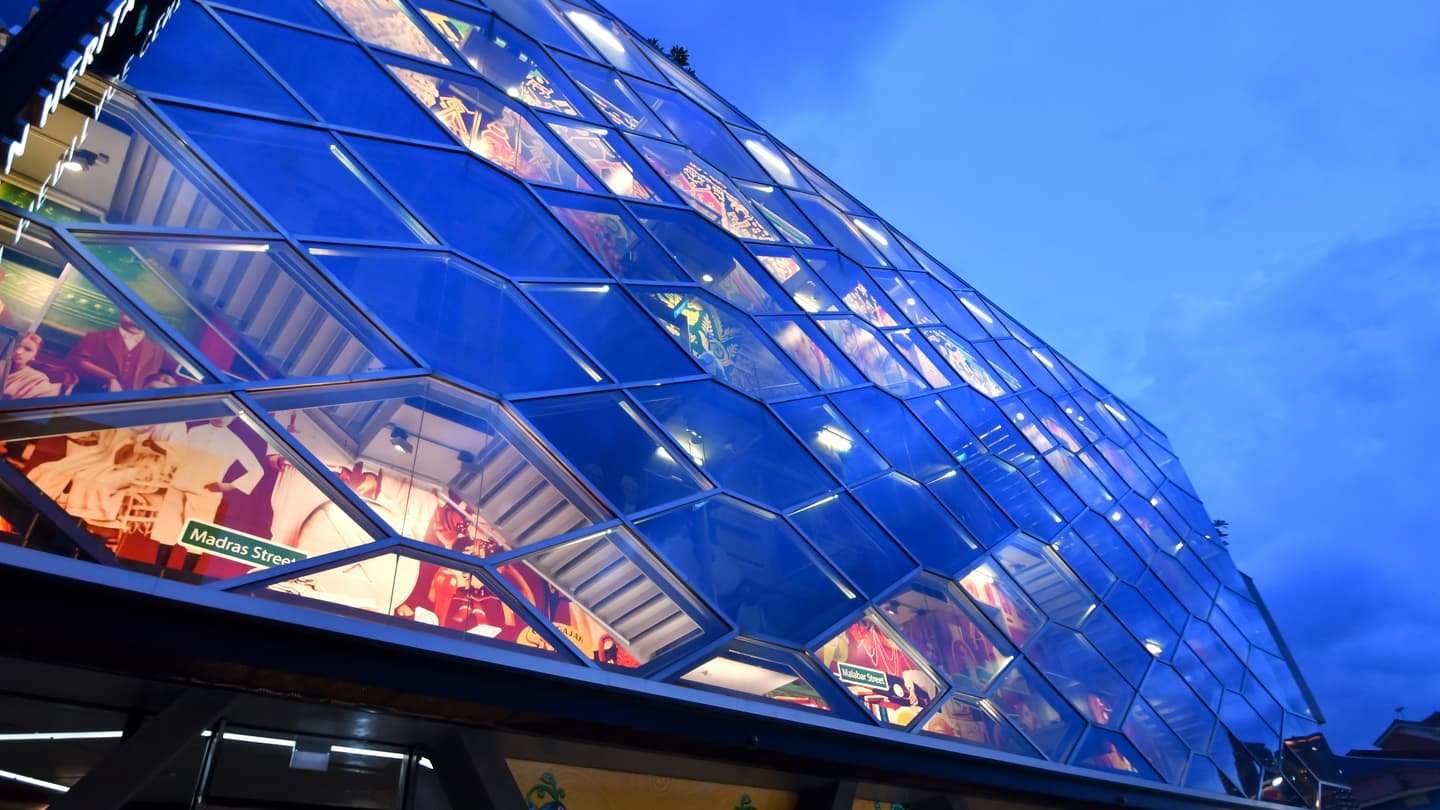
The glass building on Campbell Lane is the Indian Heritage Centre, the National Heritage Board's museum of the Indian and South Asian communities of Singapore and the region, and its permanent exhibition, Indians in Singapore: Past & Present, is the best hour of context for everything outside its windows. It opens from Tuesday to Sunday, 10am to 6pm, with last admission at 5.30pm, and adult admission for visitors is S$10.
One date to plan around: the centre closes every Monday, including a public holiday that falls on one unless it says otherwise, which puts the Deepavali holiday itself, Monday 9 November, on the wrong side of that rule. Go on the Saturday or the Sunday of that weekend instead, or on any afternoon of the festival, and time it so you come out at six into a street that is about to light up.
The Indian Heritage Centre on Campbell Lane at dusk, in 2020. Cropped and resized from a photograph by ScribblingGeek, CC BY-SA 4.0; this version is shared under the same licence.
What the festival tastes like, and where to eat nearby
Deepavali is a festival of sweets before it is anything else. The heritage board's entry notes that South Indian families like to begin the day's meals with something sweet, for a good beginning, and names the snacks made for it: mithai, the traditional sweets; adhirasam, a doughnut-like snack of rice flour and jaggery, deep-fried; murukku, crunchy and savoury; and vadai, a savoury fritter. The Festival Village is where to find them in the weeks before the day.
For a sit-down meal, the Tourism Board's guide to the neighbourhood starts with Tekka Centre on Serangoon Road, which it calls Singapore's largest indoor wet market and whose food stalls include halal options. It works like any hawker centre, so our hawker centre guide covers how the ordering and the tables go, and our must-try food post covers what to order elsewhere in the city once you have eaten your way through this one.
One Deepavali evening, drawn the way we would draw it
Put together, the evening we would plan for a guest looks like this. An afternoon at the Indian Heritage Centre, on any day but a Monday. Tekka Centre for an early dinner. Sri Srinivasa Perumal Temple as it reopens for the evening, at six on a weekday, dressed for it. Then out onto Serangoon Road as the lights come on at seven, north-east under the arches, and back down to Campbell Lane for the Festival Village, open until midnight from 10 October to 8 November. On 17 or 31 October, stay for the music from eight.
If you are still choosing dates rather than an evening, our guide to the best time to visit sets out what October and November are like, and our guide to things to do in Singapore covers the rest of the season. Elite Experiences Pte Ltd holds Travel Agent Licence No. TA04089, and every guide on our roster is individually STB-licensed. Our private tours are drawn around your dates and your pace; tell us when you land through the enquiry form, and we will come back to you in writing.
11. Indian Heritage Centre, location and opening hours and admission fees. 12. Singapore Tourism Board, Little India — the MRT stations, the Sri Veeramakaliamman Temple and Tekka Centre. The photographs are from Wikimedia Commons and credited under each image with its licence: the street and temple photographs were taken at earlier festivals, and the Indian Heritage Centre photograph is a 2020 view of the building. Every link on this page was checked on 24 September 2026.
Shall we plan your Deepavali evening in Little India?
Send us your dates and your party size. You get a written reply within 24 hours, in your language: an outline of the days and what shapes the cost. No obligation.